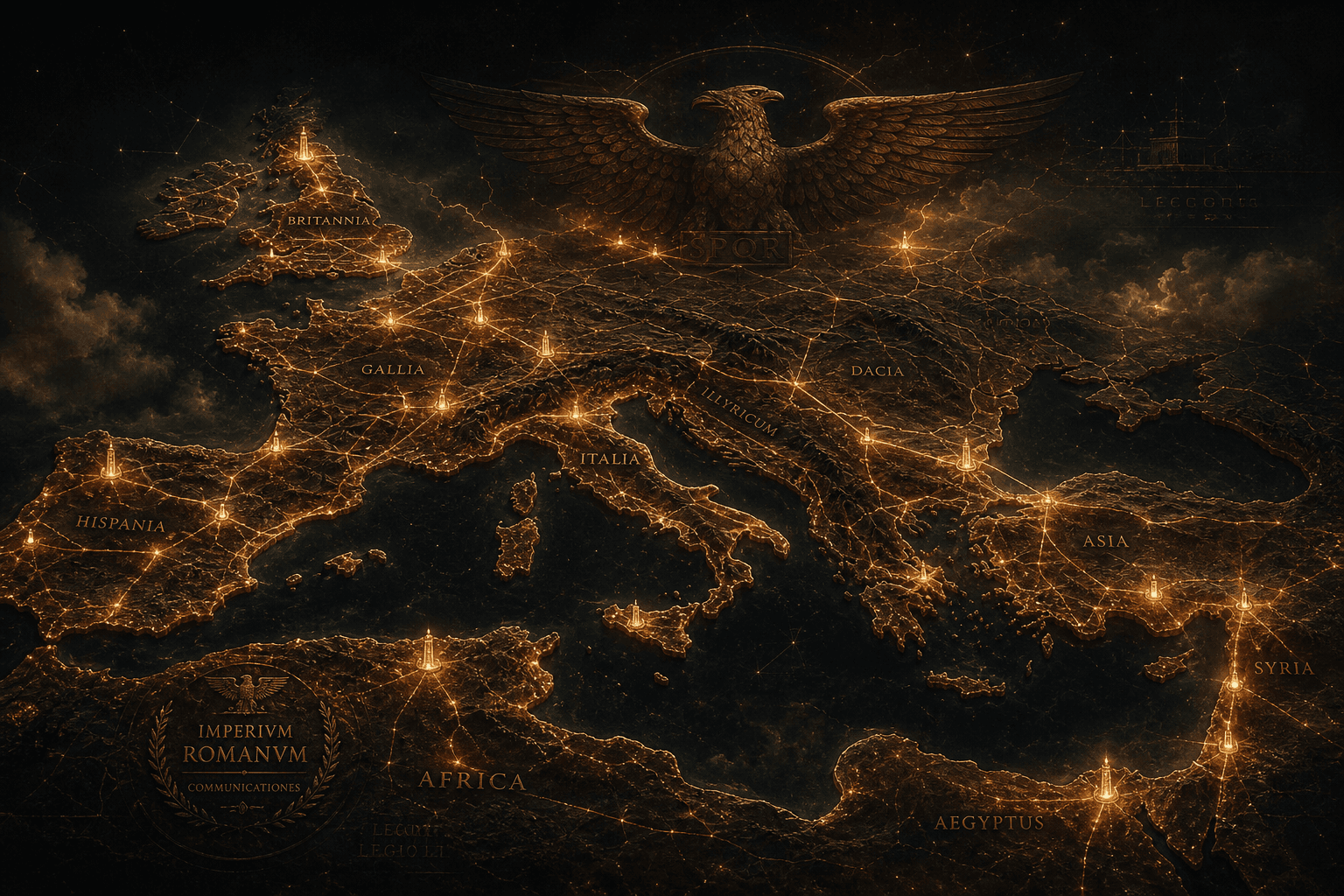
Wired Acrossthe Empire
How the telegraph would have saved Ancient Rome, and remade the world that came after it.
An empire moving at the speed of a horse.
Rome ruled the largest, most complex state the ancient world had ever seen, yet every order, every crisis response, had to be physically carried by a rider or a ship.

By the time word of a rebellion, invasion, or famine reached Rome and a response returned, the situation on the ground had already changed completely, the reply was outdated before it arrived.
In winter, Mediterranean storms shut down nearly all naval traffic, opening months-long communication blackouts with the eastern and African provinces.
This was never a failure of Roman intelligence or ambition. It was a hard technological ceiling no civilization on Earth had yet broken, and it quietly undermined everything Rome tried to build.
The delay didn’t just slow Rome down. It hollowed it out.
A communication ceiling becomes a governance ceiling. Every level of the empire paid the price.
Generals improvised wars
Commanders on distant frontiers decided war, peace, and diplomacy alone. Waiting weeks for guidance was no option, so strategy became improvised, inconsistent, and disconnected from Rome's political goals.
Corruption ran unchecked
Governors operated with near-total independence because they had no choice. By the time an investigation reached a corrupt official, he'd had months to bury the evidence or flee.
Law became a local accident
Officials enforced orders weeks or months out of date. The Rome a citizen knew in Britain was a different Rome than the one in Syria, different standards, different justice.
Rebellions outran the response
Rome's reply was always late, giving uprisings the time they needed to grow, organize, and entrench, turning local incidents into full-scale wars.
The Third-Century Crisis
Over twenty emperors in roughly fifty years. The chaos was driven in enormous part by the empire's inability to coordinate politically and militarily fast enough to hold together.
Dozens of half-empires
In practice Rome was not one civilization but dozens of semi-autonomous zones, united more by shared roads and currency than by any real-time central authority.
No one had solved this. That is the whole point.
Communication delay was a universal ceiling on how large and how stable any ancient government could become. The telegraph wouldn't just help Rome, it would place Rome in a category by itself.
Persia
A celebrated relay system, Herodotus claimed 1,677 miles in seven days. Remarkable, yet still bound by the speed of horses and the reach of roads. This was the best solution Persia ever developed, and it still could not solve the root problem.
Han China
Relay stations and signal fires along the Great Wall carried basic military alerts, but were limited by how fast a person or a flame could move across terrain. This was the best solution Han China ever developed, and it still could not solve the root problem.
Greece
Never unified into one great empire, partly because coordinating between cities was slow and unreliable enough that unity stayed more theoretical than real. This was the best solution Greece ever developed, and it still could not solve the root problem.
Rome + Telegraph
Issue and receive responses to orders in minutes, while every rival still lives under the weeks-long delay that defined all of human governance.
This is not a logistical advantage. It is a civilizational leap, the first state in human history to function as a genuinely unified, real-time government rather than a loose collection of territories run by semi-independent proxies.
Everything it needs, Rome already had.
Aqueducts that ran water across dozens of miles. Concrete domes still standing after two thousand years. The manufacturing and maintenance of a telegraph network sits comfortably within Roman capability.
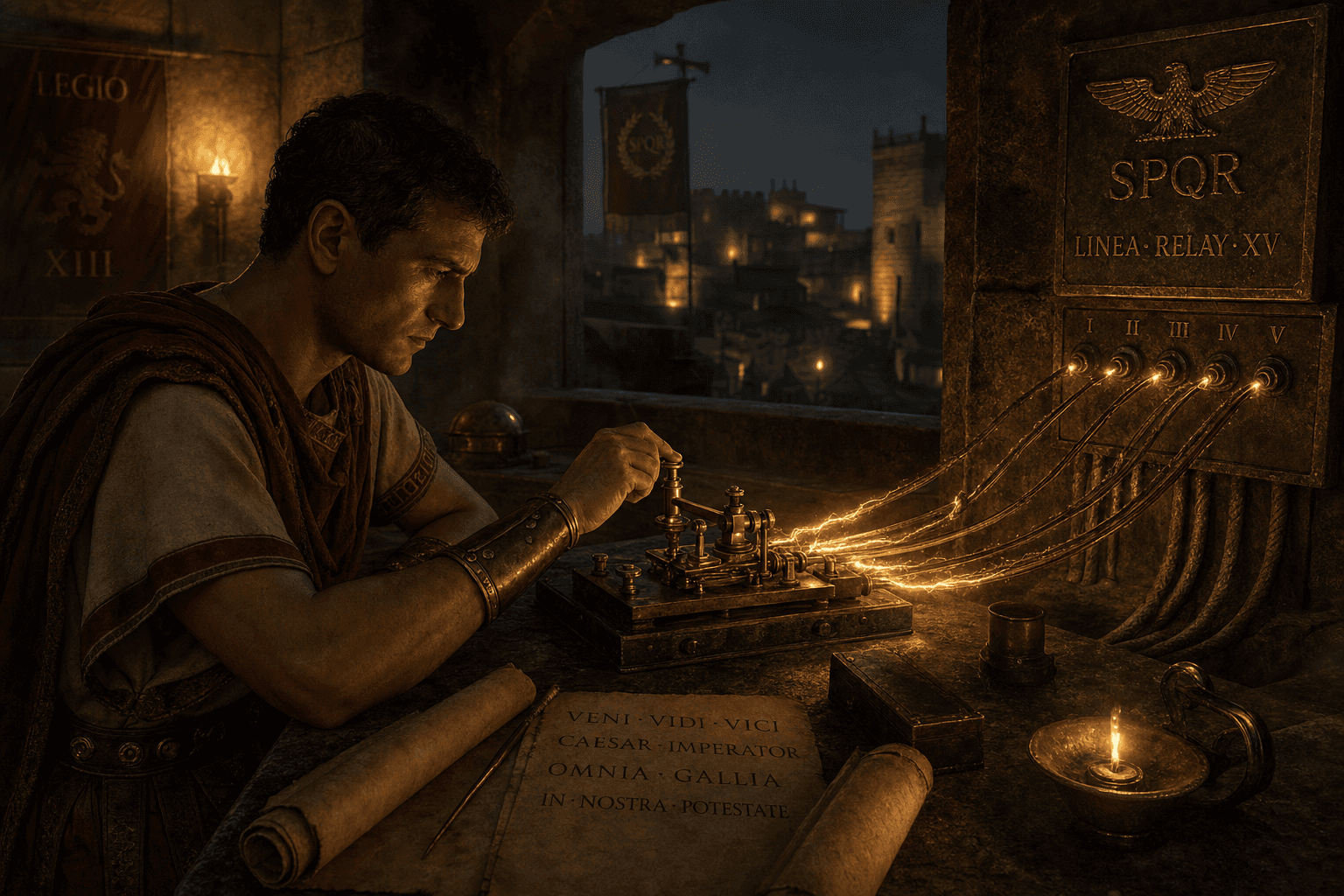
Pulses through copper
Electrical pulses travel a conductive wire; operators translate them with a simple code, most famously Morse, into letters, words, and full messages.
Copper Rome already mined
The wire would be copper, a metal Rome already mined and worked for coins, pipes, and military gear. No new extraction industry required.
Powered by its own rivers
Rivers and aqueducts already flowing through the empire drive simple waterwheel generators, powering relay stations with technology Rome already understood.
A station every 30–50 miles
Stations along existing roads receive, record, and retransmit signals, passing a message hand to hand across the empire at the speed of electricity.
An office in every city
Every major city, fort, provincial capital, and port gets a telegraph office where officials, commanders, and eventually citizens send and receive within minutes.
Trained in weeks, not years
The code is simple enough that operators train in weeks, making it realistic to staff hundreds of stations without a scarce, specialized labor force.
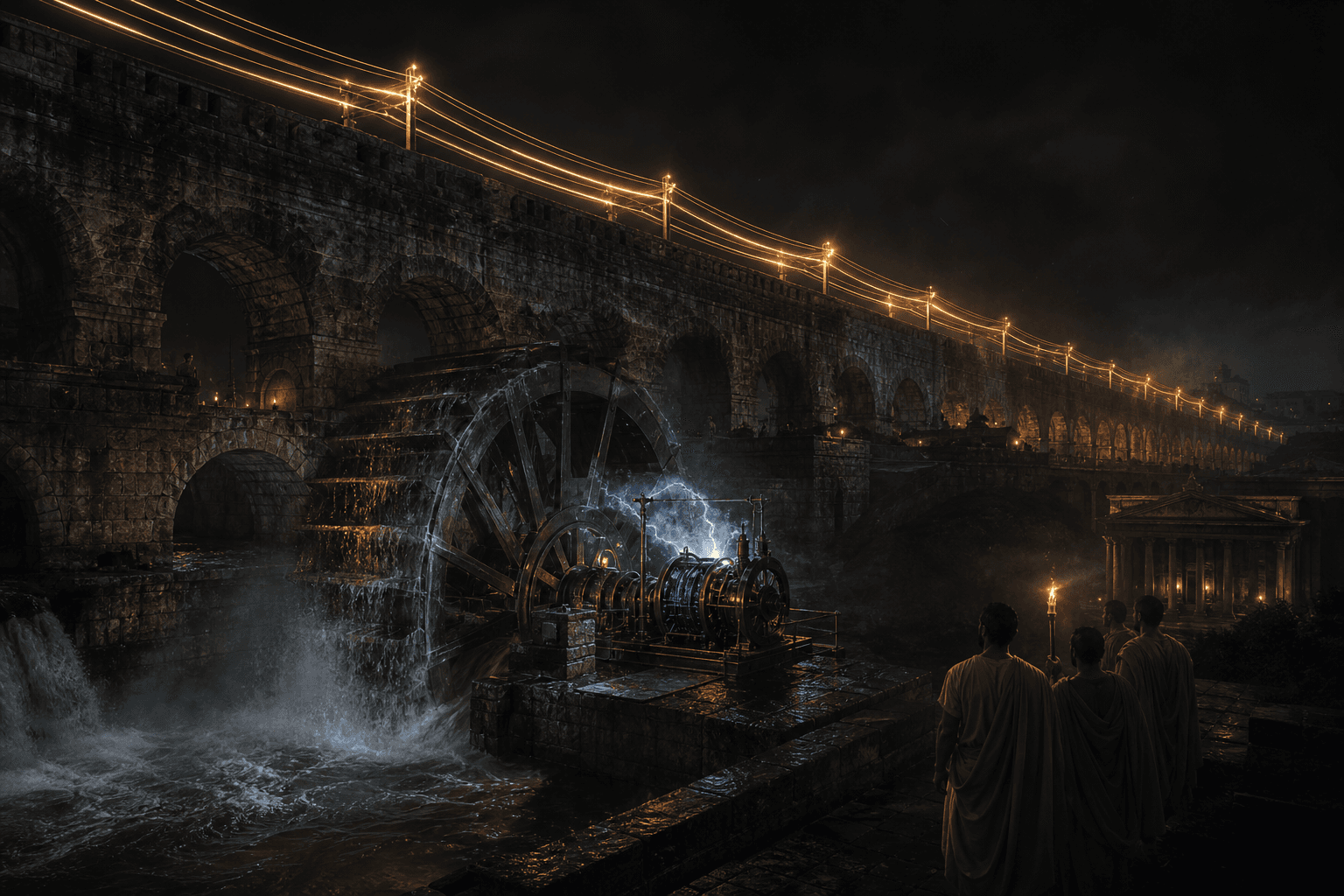
A door that, once opened, leads straight to electromagnetism.
Turning flowing water into electrical power would be the first time any civilization deliberately did so, and Roman engineers, obsessed with redirecting water, would not have stopped there.
Observe that moving water generates current, and studying electricity itself becomes almost inevitable in a culture of practical experimentation.
That trajectory points toward electromagnetism and the link between electricity and light, discoveries real history reached only in the 19th century.
The telegraph isn't just a tool. It's a door that leads Roman minds toward truths it took history another fifteen centuries to find.
Good ideas that treat the symptom, never the cause.
Four alternatives, each rejected for the same kind of reason: none can transmit complex, accurate, written information across the empire in real time without a cost or vulnerability Rome cannot bear.
Smoke Signals & Optical Signal Towers
A chain of hilltop towers using smoke, fire, or torchlight to relay signals almost instantly over line of sight.
- Genuinely fast over line of sight
- Near-instant simple alerts
- Only extremely simple pre-agreed codes
- No legal decree, military order, or complex writing through smoke or torchlight
- Hundreds of towers across mountains, deserts, and sea crossings for a tiny payload per signal
Expanded Relay Messengers
Closer-spaced horse relays passing messages rider to rider, an upgrade to the cursus publicus, Rome's actual state messenger service.
- Faster than a single messenger
- Builds on existing infrastructure
- Rome already partially implemented this, and it still was not enough
- Still capped by the speed of a horse
- Useless over open water in winter
Cell Phones
Instant, real-time communication that would be genuinely transformative for the empire.
- Instant real-time communication
- No physical line to cut between callers
- Needs towers, cables, radio signals, and advanced device manufacturing
- Even today only a handful of companies on earth can produce it
- Rome could not reverse engineer it; the attempt would consume resources and time it did not have
Landline Telephones
The same instant communication as cell phones, somewhat simpler to manufacture, but carrying the same infrastructure burden.
- Instant real-time communication
- Somewhat simpler to manufacture than cell phones
- The same enormous infrastructure burden remains
- Cutting a single central line could disconnect the entire network
- Hands anyone willing to sever a wire the means to paralyze or seize the government
One network. Minutes, not weeks.
A telegraph along the roads Rome already built, using copper it already mines and water it already redirects, closing the gap between the empire's center and its edges for the first time in human history.
Synchronized warfare
The left flank in Syria and the right in Germania receive the same order at the same moment, surprise attacks across fronts become possible for the first time.
Governors actually govern Rome's will
Officials act on current instructions instead of improvising on outdated orders. Provincial rule becomes genuinely consistent, genuinely Roman.
Uniform law, real accountability
Citizens from Britain to Syria experience fair, uniform justice because the officials above them answer to a Rome that can monitor and correct in real time.
Stable expansion
Territories Rome historically struggled to hold could be integrated as genuine parts of the state, the bottleneck that made distant provinces ungovernable simply disappears.

Every leap has a shadow. This one is long.
The telegraph does not create Rome's deepest problems, corruption, sabotage, seizure of power. It changes the form they take and raises the stakes around them.
When a message claims the eastern legions are under attack, how does Rome confirm it's real? Anyone with access to a line can intercept transmissions, send false orders, or fabricate emergencies. Until authentication, trusted-operator networks, and coded verification exist, the telegraph spreads coordinated lies as easily as truth.
Rome would not just be saved. It would become a real-time civilization.
The relay system and signal towers leave the fundamental problem unsolved. Choosing them because the telegraph is hard is choosing to let the empire keep slowly failing.
The telegraph's dangers are serious but not new. Corruption, sabotage, and power seizures defined Rome long before any wire. It changes their form, a challenge Rome's institutions were partly built to meet.
With line security, authentication, operator training, and contingency governance, Rome gains what no civilization ever had: the power to govern its own empire in real time.
The provinces stop being territories that happen to fly Roman flags and start being genuinely Roman. The emperor stops being a distant symbol whose edicts arrive months too late, and becomes a head of state whose authority is felt across the empire within the hour.